The Faculty of Nursing Holds a Scientific Conference in Celebration of the International Nursing and Midwifery Day
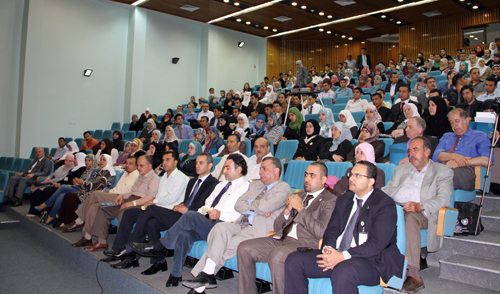
May 25th. The Faculty of Nursing at An-Najah University organized a scientific conference titled “Bridging the Gap, Increasing Chances for Access and Equality, Midwives around the World and the Focus on Maternal Mortality Worldwide” in celebration of the International Nursing and Midwifery Day. The conference was held under the sponsorship of Palestine Cellular Communication Company (Jawwal).
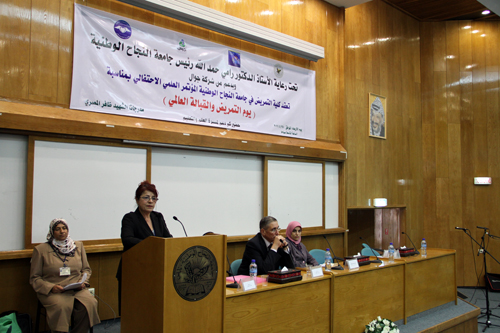
Participants in the event included: Dr. Anan Al-Masri, Deputy Palestinian Health Minister, Najat Dwaikat, Director of the Nursing Department at the Ministry, Professor Jawad Fatayer, University President Assistant for Graduate Affairs, Dr. Sam Alfoqahaa, Director of the Public Relations Department at An-Najah, in addition to representatives of several local and international organizations, Faculties’ Deans, professors, as well as a number of doctors and nurses.
Dr. Aidah Al-kaissi, Dean of the Faculty of Nursing at An-Najah, delivered a speech in which she stressed the importance of nursing and midwifery and called upon officials in academic and health institutions to invest in human resources development especially nurses and midwives. She also called for changing the stereotyped image of the nursing profession and to work on establishing some sort of a balance between the limited numbers of qualified cadres available and investment in the field of nursing.
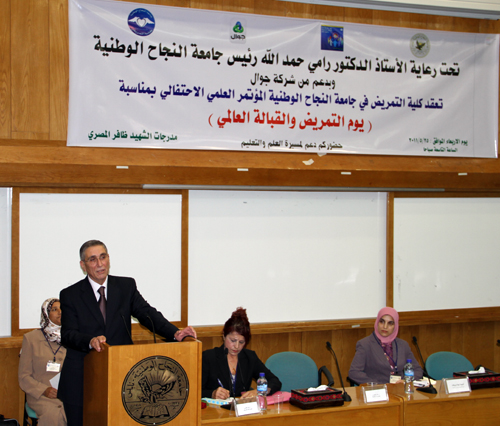
Moreover, Dr. Al-Kaissi called upon the World Health Organization (WHO) to abide by the Millennium Development Goals (MDGs) which are eight international development goals that all 192 United Nations member states and at least 23 international organizations have agreed to achieve by the year 2015. Those goals include eradicating extreme poverty, reducing child mortality rates, fighting disease epidemics such as AIDS, and developing a global partnership for development.
Dr. Al-Kaissi also explained the different items that are included in these goals such as: Achieving universal primary education, promote gender equality and empower women, improve maternal health, respect all human rights regardless of gender, color, race, faith or social rank. She also mentioned that more than 340,000 women die every year due to various illnesses because of the lack of adequate medical care and attention although most of these illnesses are treatable.
Furthermore, Dr. Al-Kaissi said that the Health Ministers’ Council is concerned with reinforcing the role of nursing and midwifery in the health systems in the Arab countries based on the importance of improving the quality of nursing services available. In 2008, the Council approved the Accreditation Tool which includes the importance of having nursing teams supervise the selection of employees and the identification of their job descriptions.
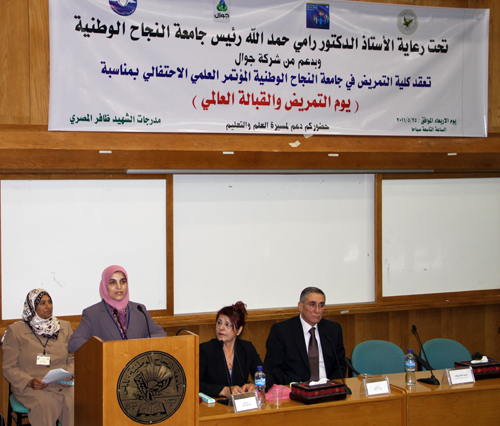
She also emphasized the importance of midwifery as a profession saying that Palestine suffers from a limited number of qualified nurses and midwives which is a very serious issue since their work is essential to reducing mortality rates among women and their children. Furthermore, Dr. Al-Kaissi called for the adoption of a national plan that would encourage young women to specialize in the field of midwifery and nursing in order to strike a balance between males and females working in this relatively male-dominated field.
At the end of her speech, Dr. Al-Kaissi thanked the University President, Prof. Rami Hamdallah and his administration staff for supporting the Faculty of Nursing and its activities. She also thanked all the local institutions and companies who sponsored the conference and valued their interest in cooperating with the University in this respect.
Dr. Al-Masri spoke about the importance of nursing as a profession and its leading role in providing services to different people in different places. He also said that nursing is a key profession that requires attention and more support to enable it to achieve its goals.
Najat Dwaikat thanked the University for supporting nursing and nurses in Palestine through its Faculty of Nursing which aims to produce highly qualified experts in nursing and midwifery to help provide the best services to the local society. Cooperation must be achieved between the University and the different nursing and midwifery institutions and to build an extensive database of those who work in the field of nursing.
In addition, the conference included a number of presentations and lectures on various topics and issues related to the conference’s main subject. Dr. Al-Kaissi presented a lecture on Malignant Hyperthermia that results from allergy to certain drugs and gases used in anesthesia.
Intisar Abu Madi from Ibn Sina Medial College spoke about the role of midwives in reducing mortality rates among women in addition to midwifery education in Palestine. Mahdiya Al-Koni from the Faculty of Nursing at An-Najah discussed bleeding after childbirth while Dr. Sahar Hassan from Birzeit University spoke about women at work; midwives during the Israeli war on Gaza: Between Bullets and Pain.
Fartohi Kokyan from Al-Quds University spoke about Eclampsia and HELLP Syndrome while Rahija Awni from An-Najah discussed the Amniotic Fluid Embolism.
In addition to the papers and lectures, a number of posters made by students from An-Najah University and Ibn Sina College were displayed at the conference. Minna Shalabi and Majd Badran presented a poster about disseminated intravascular coagulation, while Nora Ghassan and Shatha Khader presented a poster about Puerperal Fever under the supervision of Fatima Hirzallah.
Amal Bassam, a nursing student at An-Najah University, presented her graduation project in which she discussed a research study on the practices that accompany Anorexia Nervosa and the disruption of the menstrual cycle, while Khadija Kittaneh spoke about her graduation project about the nursing experience of the most common medical errors in the intensive care units.
Other posters discussed various topics such as determinants of infertility, care after childbirth, violence against women, factors related to obesity during adulthood, and many others.
The conference came out with a number of recommendations including granting nursing and midwifery students scholarships in order to encourage them to specialize in this field, facilitating the employment of nursing graduates, setting quality standards for nursing and midwifery as a profession through developing the competency of academic and medical cadres, focusing on post-graduate nursing and midwifery education, providing job description for nurses and midwives and focusing on clinical and societal scientific research.


