The Third International Translation Conference Recommends the Establishment of a National Committee for Translation
20 October 2010
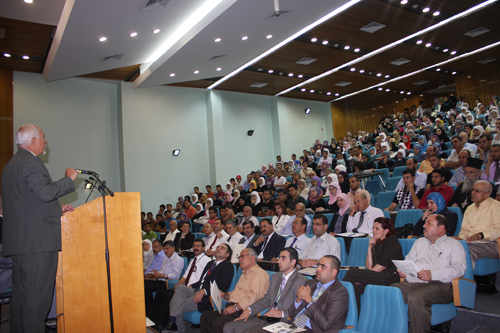
On October 20th 2010, the Third International Conference titled "The Role of Translation in Civilization Dialogue" which was organized by the Faculty of Arts at the University was concluded and came up with a number of recommendations including the establishment of a national committee that would handle and manage translation affairs.
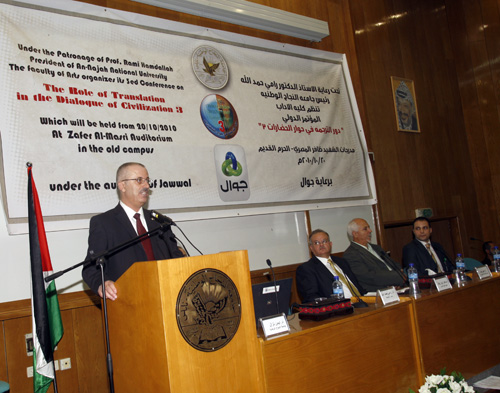
The conference was organized under the auspices of the University President, Prof. Rami Hamdallah, and supported by Jawwal (Palestine Cellular Communications Company) at the Martyr Zafer Al-Masri Auditoriums a the Old Campus. Attendees included: Dr. Maher Abu Zant, Dean of the Faculty of Arts, Prof. Yahya Jaber, Head of the Organizing Committee, Mr. Ameer Turkyyeh, as representative of Jawwal, in addition to a number of Palestinian, Arab and foreign scholars from the different Palestinian, Arab and international universities.
At the conference's opening, Prof. Hamdallah delivered a speech in which he welcomed the participants and valued their attendance to the conference which he described as a major event in Palestine. He spoke about the importance of language and its role in the preservation of civilizations and cultures and said that a nation with a weak language can not survive. It is not wrong for a nation to move forward and develop as long as this development does not interfere or eliminate its culture or original values. Any nation must take and benefit from other nations but it should be aware not to let other cultures destroys its own culture.
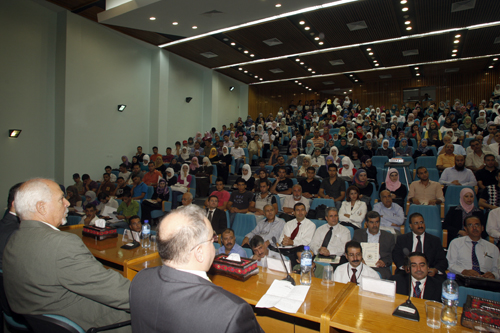
He added that civilization is a combination between the physical and spiritual things; therefore, the relationship between civilizations must consider that dialogue between nations means that people meet together and discuss shared ideas. Dialogue between civilizations can lead to mutual benefits and achieve better understanding between people from different cultural, social, religious and ethnic backgrounds.
Dr. Abu Zant spoke about the importance of the topic that the conference discussed and said that translation involves two sides each of which possesses a very different culture, traditions, habits, ideas, way of thinking and other aspects. Those aspects must be considered when carrying out a cross-cultural dialogue.
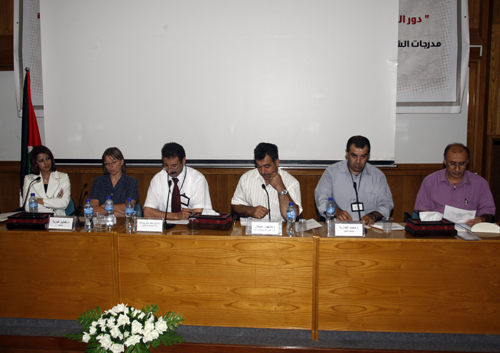
The conference included two sessions. The first one featured a number of work papers that discussed several topics including: "The Role of Translation in Civilization Dialogue-III: Translation between the Poles of Accurate Text Reproduction and Adaptation to Target Readerships", "The Role of Translation Movement in the Process Civilization Interaction and Cultural Understanding: A Study of Abbasid Period", "The Role of Translation in Translated Children Stories", "The Translation of Turkish Documents to Arabic in Palestine: A National Necessity", "Translation and National Identity", "The War of the words", "Children Literature between Translation and Simplification", "The Translation of Modern Arabic Poetry into English: The Dilemma of Meaning", "My Initial Encounter with the Deceased Hans Vermeer", "Translation and Globalization", and "The Translation of Deconstruction Terminology".
Other topics also included: "Translating Reference Switching in the Quranic Discourse: Shift of Number as an Example", "Translation and Ideology: Adel Zu'aiter as an Example", and "Songs (And Lyrics) in Translation", "Political Translation".
The world is in need of a fruitful and effective communication and dialogue which would help people come closer to one another's ideas and thinking. Due to the diversity of the world's nations in terms of culture, tradition, habits, beliefs, traditions, and ideas, interaction between people must be directed towards reinforcing better understanding between them. Diversity is a fact and can not be ignored, however, it is up to us to try to bring people together and bridge the gaps that exist between nations. Nations, though diverse, can benefit from each other's cultural values, technological development, and ideas. Here arises the importance of translation in making the exchange of knowledge and information between countries and nations easier and more effective.


