The American Studies Resource Center Organizes a Workshop for an Expert from Microsoft Corporation
05 December 2010
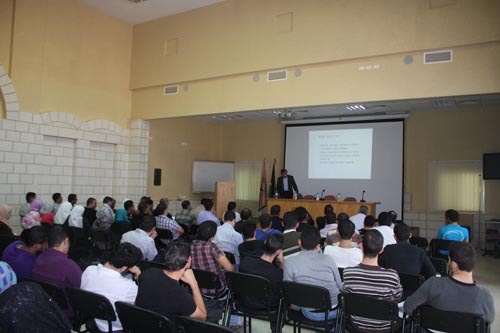
On November 30th 2010, the American Studies Resource Center at the University in cooperation with the United States Consulate General in Jerusalem received Professor Mark Steven Baker, Senior Programming Writer from Microsoft Corporation in the United States. The Center organized a workshop for the visiting professor at the Conferences Room at the Old Campus library. Attendees included Dr. Ayman Nazzal, the Director of the American Studies Center, Dr. Khalid Barham, the Director of the Korean-Palestinian IT Institute of Excellence, as well as a number of the technical staff at the University.
Professor Baker holds degrees in Architecture, Electrical Engineering (Semiconductors) and Urban Planning. In 1966 he learned to program on IBM punchcards. He also worked as a computer magazine editor between 1985 and 2000 and carried out consulting work for companies including Cisco, Microsoft and others.
The workshop consisted of three sessions two of which were organized at the Old Campus while the third one was held at the Faculty of Information Technology and Korean-Palestinian IT Institute of Excellence at the New Campus. The first session was dedicated to a presentation by Professor Baker who spoke about systems administration and the use of information technology in different institutions, especially academic ones.
At first, he spoke about the experience he had during his visit to Palestine and his close examination of information technology systems used in educational institutions in the country. He then described his education and achievements over the past years and how information technology developed from early computers to the modern ones. He said that he depends on using computers in his research work, in writing articles and in editing them too.
He said that education is best achieved through experience and learning from mistakes; to learn how to fix problems and create solutions for them. He then spoke about system administration and the objectives of this process.
After that, he explained the different principles of system administration which included documenting systems, automating tasks, making use of remote management, backing up important files and data. He also highlighted the steps that are involved in system administration and tasks management which includes managing updates, hardware updates and others. He said that in the past experts were not worried about issues of security as they are now because computer threats were not as common as they are today. Most research is now carried out on security and updates of systems.
Moreover, he spoke about the automation of tasks and emphasized the importance of this process and to carry it out whenever possible. Other topics covered network configuration, security, client configuration, core network services, network troubleshooting, network application services, open source software, and others.
He also spoke about networking problems in Palestine which include slow connections to internet, dependence on a few internet providers such as Hadara and others, problems with network configuration, lack of experience with troubleshooting network problems, and limited expertise in managing network services.
In the second session, Professor Marwan Haddad, the Director of the Water and Environmental Studies Institute at the University, delivered a presentation about solar energy. Professor Haddad spoke about future plans regarding the use of solar energy in Palestine, joint scientific research projects in the field of solar energy to solve water and environment problems. He also mentioned several examples of such uses including the installation of solar panels on the roofs of buildings to produce electricity. He explained how such technology reduces energy consumption and helps in saving money.
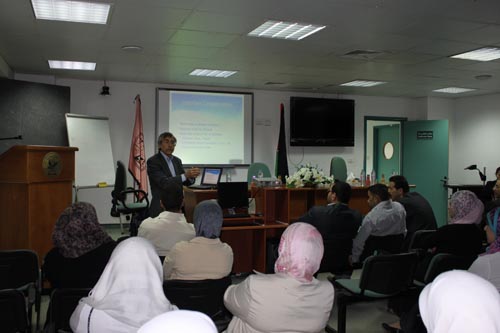
Professor Baker, who worked on solar energy research and development between 1968 and 2000, presented a detailed illustration of the development of the use of solar energy since the end of the 18th century to this date. He also spoke about his work in solar radiation monitoring, modeling solar radiation on tilted surfaces, modeling passive solar heating and cooling in buildings, monitoring various solar energy projects, and developing state incentives in Oregon to promote solar energy use.
In his speech, Professor Baker explained several topics including solar energy uses, barriers to solar and renewable energy such as lack of government support and nature of resource. He also spoke about historic developments of solar energy use from the early 1500s to 1940 including the use of greenhouses, selenium solar cells, solar concentrating parabolic collectors, and solar water heating. Furthermore, the Professor mentioned the many improvements that were introduced regarding solar cells such as increases in efficiency, dramatic reduction in costs, the use of new materials such as polycrystalline silicon, amorphous silicon, gallium arsenide…etc).
Professor Baker holds degrees in Architecture, Electrical Engineering (Semiconductors) and Urban Planning. In 1966 he learned to program on IBM punchcards. He also worked as a computer magazine editor between 1985 and 2000 and carried out consulting work for companies including Cisco, Microsoft and others.
The workshop consisted of three sessions two of which were organized at the Old Campus while the third one was held at the Faculty of Information Technology and Korean-Palestinian IT Institute of Excellence at the New Campus. The first session was dedicated to a presentation by Professor Baker who spoke about systems administration and the use of information technology in different institutions, especially academic ones.
At first, he spoke about the experience he had during his visit to Palestine and his close examination of information technology systems used in educational institutions in the country. He then described his education and achievements over the past years and how information technology developed from early computers to the modern ones. He said that he depends on using computers in his research work, in writing articles and in editing them too.
He said that education is best achieved through experience and learning from mistakes; to learn how to fix problems and create solutions for them. He then spoke about system administration and the objectives of this process.
After that, he explained the different principles of system administration which included documenting systems, automating tasks, making use of remote management, backing up important files and data. He also highlighted the steps that are involved in system administration and tasks management which includes managing updates, hardware updates and others. He said that in the past experts were not worried about issues of security as they are now because computer threats were not as common as they are today. Most research is now carried out on security and updates of systems.
Moreover, he spoke about the automation of tasks and emphasized the importance of this process and to carry it out whenever possible. Other topics covered network configuration, security, client configuration, core network services, network troubleshooting, network application services, open source software, and others.
He also spoke about networking problems in Palestine which include slow connections to internet, dependence on a few internet providers such as Hadara and others, problems with network configuration, lack of experience with troubleshooting network problems, and limited expertise in managing network services.
In the second session, Professor Marwan Haddad, the Director of the Water and Environmental Studies Institute at the University, delivered a presentation about solar energy. Professor Haddad spoke about future plans regarding the use of solar energy in Palestine, joint scientific research projects in the field of solar energy to solve water and environment problems. He also mentioned several examples of such uses including the installation of solar panels on the roofs of buildings to produce electricity. He explained how such technology reduces energy consumption and helps in saving money.
Professor Baker, who worked on solar energy research and development between 1968 and 2000, presented a detailed illustration of the development of the use of solar energy since the end of the 18th century to this date. He also spoke about his work in solar radiation monitoring, modeling solar radiation on tilted surfaces, modeling passive solar heating and cooling in buildings, monitoring various solar energy projects, and developing state incentives in Oregon to promote solar energy use.
In his speech, Professor Baker explained several topics including solar energy uses, barriers to solar and renewable energy such as lack of government support and nature of resource. He also spoke about historic developments of solar energy use from the early 1500s to 1940 including the use of greenhouses, selenium solar cells, solar concentrating parabolic collectors, and solar water heating. Furthermore, the Professor mentioned the many improvements that were introduced regarding solar cells such as increases in efficiency, dramatic reduction in costs, the use of new materials such as polycrystalline silicon, amorphous silicon, gallium arsenide…etc).
A third session was organized for Professor Baker at the Faculty of Information Technology at the New Campus in which he spoke about different network administration, programming, wireless communications, networks management, networking application programming, as well as other similar issues. Such workshops are o f great importance to the University and its technical staff because they bring them close to international experts in the field of information technology and enable students to benefit from their expertise and knowledge. The field of information technology is now involved in almost every aspect of life and is considered an indispensable part of the development of any society.


