Organizing a Workshop at An-Najah University for the Palestinian Prisoners Day
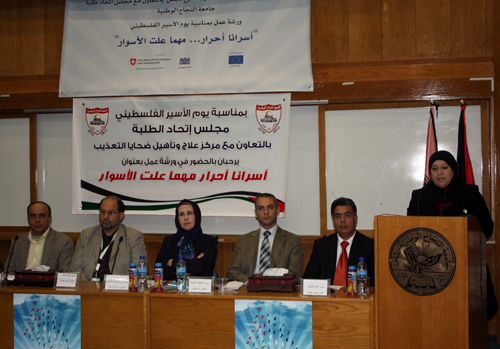
On April 12th, the Treatment and Rehabilitation Center for Victims of Torture (TRC) organized a workshop titled “Our Prisoners are Free no matter how High the Walls are” on the occasion of the Palestinian Prisoners Day (17th of April every year) in cooperation with the Students Union Council at An-Najah at the Martyr Zafer Al-Masri Auditorium, Old Campus.
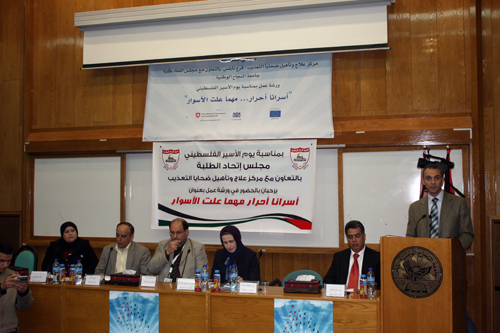
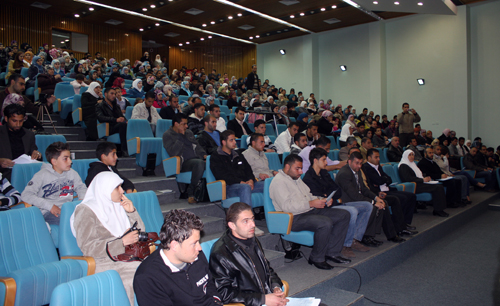
Attendees included Dr. Najat Abu Baker, Member in the Palestinian Legislative Council, Mr. Muhammad Al-Batta, Director-General of the Rehabilitation Department at the Ministry of Detainees and Ex-detainees Affairs, Rana Sha’ban, as representative of Nablus Governor, Brigadier Jibrin Al-Bakri, Dr. Sam Afoqahaa, Director of the Public Relations Department at An-Najah, Ra’ed Amer, Director of the Detainee Club in Nablus, Dr. Akram Othman, Director of the North branches at the TRC, in addition to a number of ex-detainees, their families and university students.
Mrs. Amani Mu’di, Director of the Awareness Unit at the TRC, gave a speech in which she said that the TRC celebrates the Palestinian Prisoners Day every year and chooses a certain topic related to the detainees’ issue to talk about. This year, she said, the Center chose to talk about the old, sick and young detainees; Mu’di also called for a national campaign to exert pressure on Israel to end the suffering of the Palestinian detainees inside the Israeli prisons.
Dr. Alfoqahaa on his part gave a speech in which he welcomed the participants to the workshop on behalf of the An-Najah, its administration and students saying: “On the 17th of April each year, the Palestinian people commemorate the Palestinian Prisoners Day which they first commemorated on the same day in 1974 which was the day on which the first Palestinian detainee (Mahmoud Baker Hijazi) was released as part of the first exchange deal between the Palestinians and the Israeli occupation.”
Dr. Alfoqahaa also emphasized that the detainees’ issues is considered as one of the most important and most sensitive issue for the Palestinians who strive to achieve independence and freedom. He added that since the establishment of An-Najah University, hundreds of its students and teachers have been subject to imprisonment by the Israelis and over the years of the Palestinian Uprising (Intifada) the number of Palestinian detainees climbed.
For this, Dr. Alfoqahaa said that the University goes hand in hand with the detainees’ families and endeavors to help them in many ways; An-Najah has always been in the center of the Palestinian situation. He added “The darkest part of night is that which is just before dawn…we know you can face the difficult situation with your strong will; freedom is inevitably coming”.
After that, Mr. Al-Batta spoke about old-detainees and said that the issue of detainees is an important one in the history of the Palestinian people particularly those who have been in prison for a long time. He explained that there are more than 308 old detainees, Na’el and Fakhri Al-Barghouthi and Akram Mansour being the oldest. He also said that more than 32 detainees have spent more than 20 years in prison while 19 detainees have spent more than 25 years in Israeli prisons.
Al-Batta explained that the old detainees originate from the different cities in Palestine and the Arab world; 40 of them are from Jerusalem, 20 from 1948 lands, 121 from Gaza, 126 from the West Bank, and one Arab detainee from the Golan Heights. Moreover, there are many cases of sick detainees 122 of whom died because of medical negligence while more than a thousand detainees are suffering from different diseases and illnesses.
Al-Batta called for the establishment of a unified strategy to launch an extensive international campaign that is based on a national consensus which will be spread to the Arab countries and the world. Ra’ed Amer said that there are many Palestinian detainees who suffer from chronic diseases such as cancer, and what makes things worse is the fact that the Israeli government refuses to treat those cases. This requires an internationalization of the detainees issue in order to raise the world’s awareness regarding this significant cause.
Abu Baker on her part spoke about the suffering of the Palestinian male and female detainees being a political issue and called upon officials to bring the detainees cause to the International Court of Justice so as to release those detainees. She also called for the organization of a conference to discuss the Geneva Conventions relative to the treatment of detainees and the ending of the Palestinian internal division.
Dr. Othman spoke about the psychological and social impacts of imprisonment on the detainees and defined torture as practicing a physical or psychological coercion on the detainee in order to extract information from him; those impacts can last for a long time.
Mr. Ayman Al-Masri, Instructor at the Faculty of Media at An-Najah, described the role of media in uncovering the Israeli violations against the detainees and called for utilizing the available technologies to support the detainees’ issues.
The workshop also included a poem by a mother of two detainees as well as a play titled “Eid Joy” which was performed by a number of detainees’ sons.


