Organizing a Meeting for the European Parliament Delegation with a Number of University Students
29 November 2010
On November 29th 2010, the Public Relations Department at the University organized an open meeting for the members of the European Parliament Delegation with a number of University students and instructors. The meeting was held at the New Campus Library where the Delegation members spoke about different issues related to the Palestinian cause and current situations on ground.
The Delegation, which is currently visiting Palestine, consisted of a number of members from different countries that make up the European Union including the United Kingdom, France and Germany. Members included Mr. Proinsias De Rossa, Chair of the Delegation, Vice-Chair Margrete Auken, Niccolò Rinaldi, Sir Robert Atkins, Nicole Kiil-Nielsen and others.
The meeting which was administered by Dr. Akram Daoud, Dean of the Faculty of Law at the University, focused on familiarizing the Palestinian public with the position and stance of the European countries towards the Palestinian cause and the efforts that the European Union (EU) has exerted so far to support the Palestinians and their quest to achieve independence and freedom. The meeting's main speaker was Mr. De Rossa who started by introducing the Delegation's members to the audience.
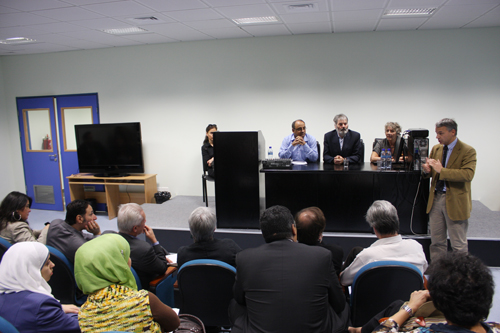
He explained that the Delegation's goals were to ensure that the policies of the European Parliament reflect the desires of the Palestinians and that they support the establishment of a future democratic state in Palestine. He added that the European countries are working on supporting the Palestinians but the process is a slow one since the EU consists of 27 member states, which means that an issue would have to be presented to each member state independently to obtain approval and recognition. He said that achieving freedom requires perseverance and that education can lead to independence. The Palestinians need to free themselves and their minds and focus on education because only educated leaders can lead the way to achieve independence and the establishment of the new state.
Other members of the Delegation focused their speech on advising the Palestinians to try to work on solving the inter-Palestinian divide and achieve reconciliation. They emphasized the importance of unity; democracy always involves different parties each of which has its own ideas and principles. However, no matter how many parties there is, people must become unified to stand as one against oppression and occupation.
Moreover, the Delegation's members said that the problem is that the Israeli media is professional and effective which means that most Palestinian stories go untold. They agreed on the illegality of most of the Israeli practices and policies against the Palestinians such as home demolitions, land confiscation, imprisonment, violation of human rights and others, but the most important thing is what strategies should be adopted to try to protect the Palestinians and ensure that their rights are secured.
The Delegation also received questions from the audience, mainly students, who raised questions over issues that directly affect their life. Students asked questions about the efforts that the EU is exerting to support them and their cause. They also spoke about their own stories that they lived and live everyday under occupation.
The Delegation's members stressed that the EU is working hard to accomplish more real steps that could have a substantial influence on Israel. They said that their visits to Gaza and different parts of Palestine have introduced them to the various situations on ground and the conditions that the Palestinian families are going through.


