Concluding the Workshops on Economic, Social and Cultural Rights (ESCRs) in the West Bank
03 October 2010
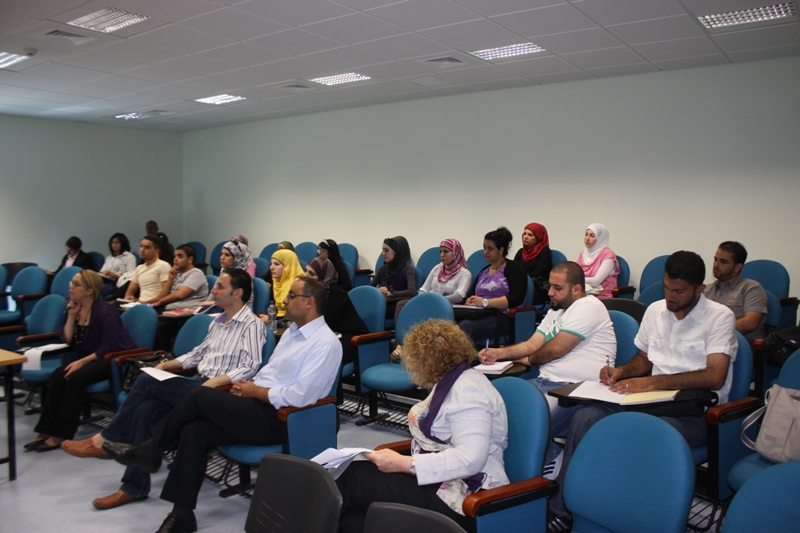
On September 29th 2010, the Faculty of Law at An-Najah University concluded a series of workshops which addressed economic, social and cultural rights (ESCRs). The workshops, which were funded by the British Academy, were organized between the 26th and 28th of September 2010 at the University in cooperation between An-Najah and Lancaster University in the United Kingdom. The workshops targeted Law students and professional lawyers in Palestine and aimed to raise awareness among them regarding ESCRs, the major challenges that hinder their implementation and how to implement them in Palestine.
Major lecturers were Professor Victoria Mason, Lecturer in the Politics and International Relations of the Middle East and the Politics of Human Rights, Richardson Institute for Peace and Conflict Resolution, Lancaster University, UK as well as Professor Claire Mahon, an international human rights lawyer based in Geneva, Switzerland and a joint Coordinator of the Project on Economic, Social and Cultural Rights (ESCRs) at the Geneva Academy of International Humanitarian Law and Human Rights.
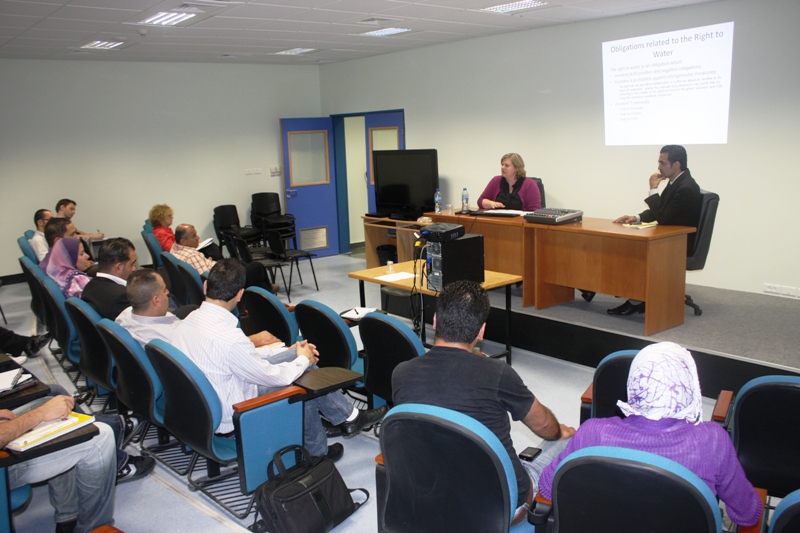
Other lecturers included Professor Linda Briskman, Chair in Human Rights Education at the Centre for Human Rights Education, Faculty of Humanities at Curtin University in Australia, as well as Professor Sandra Nasr. The workshops addressed a major subject which is the economic, social and cultural rights of the human being. This topic also included the discussion of several subjects related to human rights. On the first day, Professor Mason gave an introduction on the Economic, Social and Cultural Rights (ESCRs) in the West Bank and the status of these rights under the Israeli occupation.
Professor Mason spoke about the marginalization of ESCRs in the human rights regime and the fact that more concern has been given to civil and political rights than to ESCRs. The discussion of ESCRs on global scale has been very weak and fragmented since the focus has long been on civil and political rights. Professor Mason argued that ESCRs are closely related to other kinds of rights such as civil and political rights, therefore, governments must start to study those rights if they want to secure a comprehensive scope of rights for the people. However, much work and pressure is still required because ESCRs still receive comparatively little attention.
.JPG)
Professor Mason also spoke about cases of grave violations of different rights in the West Bank in Palestine such as the right to self-determination, the right to an adequate standard of living, the right to health, the right to work, the right to education and the right to water. She explained that those violations have been the result of many practices by the occupation such as severe restrictions on movement as a result of the Separation Wall, checkpoints, curfews and closures, de-institutionalization of the Palestinian economy, expropriation of the Palestinian land and resources discriminatory laws and collective punishment.
Explaining her participation in the British Academy Project, Professor Mason said that the Project includes a series of workshops and conferences held in the West Bank and UK interchangeably over three years starting from September 2010 to 2012. The workshops will address normative content and obligations of specific ESCRs, problems and lack of enjoyment in the West Bank context, establishing violations in the West Bank and remedy issues. She also described the Academy's plan to bring academics and NGOs together to discuss violations of ESCRs in the West Bank and propose adequate remedies. Professor Mason also mentioned a number of aims and outputs of the Project including the establishment of a network in which practitioners and scholars work together to deal with violations of ESCRs, building strategies to raise awareness of ESCRs in the West Bank and in the world, and to look at how people could effectively implement ESCRs through impacting Israeli policy and adopt wider lobbying in order to achieve better results.
Furthermore, Professor Mason said that through her work on human rights issues, she found that there is very little literature about ESCRs and a small amount of research has been conducted in this field, therefore, she called for the issuing of international leaflets providing information to raise awareness regarding ESCRs, publishing more books and articles on this issue and more policy-oriented reports directed at key stakeholders (such as the DfiD).
Professor Mason mentioned that there are major challenges that make the implementation of ESCRs difficult such as the focus on civil and political rights, the Israeli impunity and the Israeli denial of international human rights law. She said that the Palestinians must be aware of their rights and how to pursue them. The world must know about the situation in Palestine and the violations of ESCRs there.
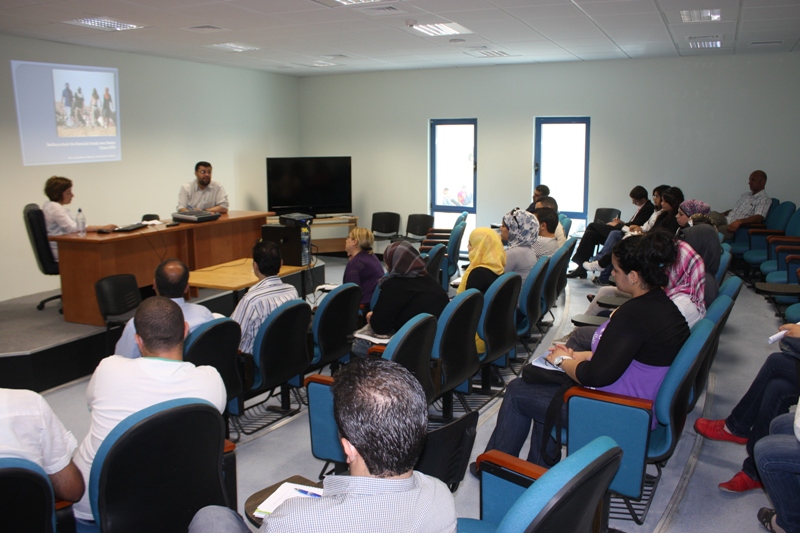
The next lecture was delivered by Professor Claire Mahon who spoke about Economic, Social and Cultural Rights (ESCRs): Procedures, Monitoring, Implementation and Remedies. Professor Mahon explained that ESCRs are justifiable, and progressively realized according to Article 2 (1) ICESCR: "Each State Party to the present Covenant undertakes to take steps, individually and through international assistance and co-operation, especially economic and technical, to the maximum of its available resources, with a view to achieving progressively the full realization of the rights recognized in the present Covenant by all appropriate means, including particularly the adoption of legislative measures.".
She also said that the implementation of ESCRs must involve immediate realizable obligations including: The obligation not to discriminate between different groups of people in the realization of the rights in question, the obligation to take steps targeted towards the full realization of the rights, and the obligation to monitor progress in the realization of human rights. Mahon also explained that ESCRs are included in the resolutions of the Human Rights Council and former Commission on Human Rights, conventions of the International Labor Organization, General Assembly resolutions and the customary international law.
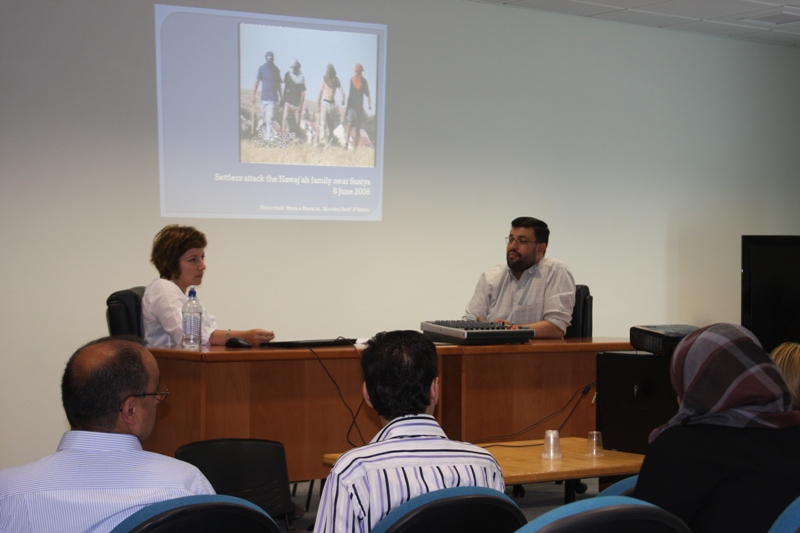
Professor Mahon also stressed the three duties that government must consider when dealing with the rights of people. Such duties include the duty to respect, the duty to protect and the duty to fulfill. This means that the government must respect the people's rights and their freedom to fulfill those rights; it must protect those rights and ensure that individuals obtain them. She also explained the means through which ESCRs can be monitored including: investigating complaints of violations, unwillingness of states to fulfill, and monitoring governments' obligations and commitment towards securing people's rights.
Professor Mahon also suggested a number of mechanisms and procedures for monitoring and seeking remedies on the national level through courts, ombudsman, national human rights institutions and media, and also on the international level through the Committee on ESC Rights, special procedures and Human Rights Council. Professor Mahon also pointed out that there are other international mechanisms that must be used to ensure the implementation of ESCRs including the International Court of Justice, General Assembly, Security Council, UN specialized agencies (such as the UNESCO and ILO), the World Bank Inspection Panel, OECD National Contact Points as well as regional human rights courts and tribunals.
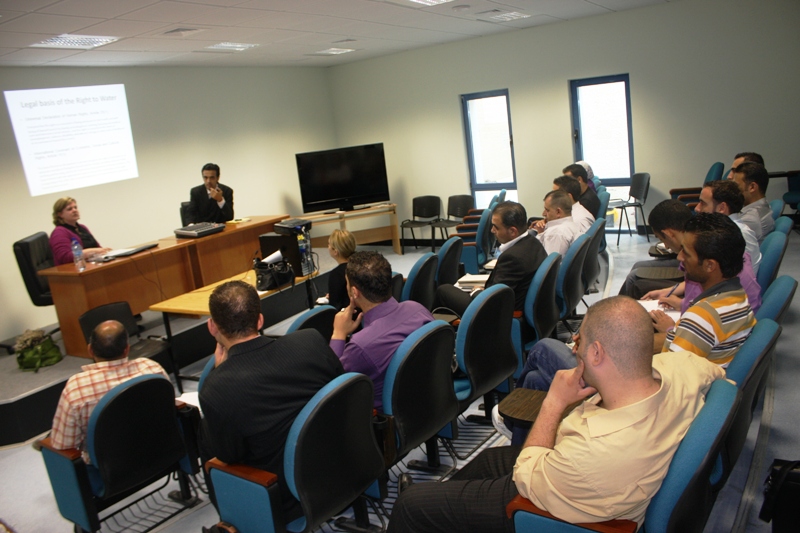
The Professor further explained the structure of the Committee on ESCR which consists of 18 experts who are independent and working in their personal capacity and who are geographically representative, the Committee's role is to provide interpretation of articles of the ICESCR and development of international law, monitors the implementation of ICESCR, meets in Geneva twice every year-May-November in addition to other tasks. The ESCR Committee has special procedures that include: Special Rapporteur on the right to food, special Rapporteur on the right to adequate housing, special Rapporteur on the right to education, special Rapporteur on the right to health, independent expert on the question of human rights and extreme poverty, independent expert on the issue of Human Rights Obligations as well as other procedures.
Professor Marwan Haddad, the Director of the Water and Environmental Studies Institute at An-Najah, delivered a lecture in which he spoke about the water status in Palestine and the problems that the Palestinians face in this respect. He said that the Israelis have taken over a large percentage of the water resources in the West Bank which left the Palestinians deprived from their right to water. The right to water is part of the ESCRs, thus, violation of this right is a violation of the rest of them. He also explained that restrains on the Palestinians' access to water makes it very difficult for the Palestinian agriculture to develop, this leads to deterioration of the whole economy. Sustainable water supply is the key for achieving peace and stability.
.JPG)
Other sessions were lectured by Professor Nasr who spoke about the right to move and how Palestinians are experiencing difficulties regarding their movement from one place to another. This makes achieving other rights extremely difficult.
These workshops aimed to raise awareness among Palestinians regarding their rights, particularly ESCRs which are being gravely violated in Palestine. They also aim to familiarize Palestinian lawyers and law students with the international effort that many organizations and institutions of human rights are carrying to implement ESCRs. Such event is extremely important for the Palestinian law practitioners and experts since it aims to bring national and international experts together to try to cooperate and coordinate efforts that can influence the governments' policies and direct them towards respecting and protecting human rights.
A series of similar future workshops will be held both at Lancaster and An-Najah over three years from now that would discuss topics related to Right to Self-Determination, Right to Education and others.


